
“The Invite” Is About More Than Swinging—It’s About Saving Your Marriage
When I walked into the AMC Webster 12 and purchased my ticket to see The Invite, I had no idea what to expect. I knew the movie had a stacked cast headlined by Seth Rogen, Olivia Wilde, Penelope Cruz, and Edward Norton, was sitting at 96% on Rotten Tomatoes, and that I generally like Seth Rogen and his projects. As I began the walk into the theatre, I had my first glimpse of the poster. The tagline read “Everything is on the table”. In retrospect, that should’ve given me some idea of what I was getting into, or at least a twinge of pause. Nevertheless, armed with naivete and the soul of a film critic, I soldiered on. I sat down, opened my smuggled Skittles, emphatically recited the Lord’s Prayer with my eyes closed during the horror trailers (just not my thing), and prepared for what I was sure was going to be Rogen’s normal brand of stoner comedy a la Superbad. To put it frankly, it was not that. A lot of that has to do with the fact that this is not a Seth Rogen movie, but an Olivia Wilde… experience. Of course, I would have known that had I bothered to do even a cursory search for the film before I walked in. What I would not have known, however, was that this picture about swingers, free love, and sexual exploration would offer the purest defense of marriage, and more specifically your marriage.
I’ll admit, I’m not married, though it certainly isn’t for lack of trying. I’ve been in a handful of failed relationships, so like most men, I consider myself a dating expert. The Invite speaks to the biggest problem I see plaguing the dating scene I currently live in. That is what I will lovingly call “Greener Grass Syndrome”, the idea that in this big open world, there is someone, somewhere, who is better looking, better talking, better loving, or generally better suited for you. That if you just give up and go home, you will find the love of your life, or at least the next few weeks of your life, before you inevitably move to the next one.
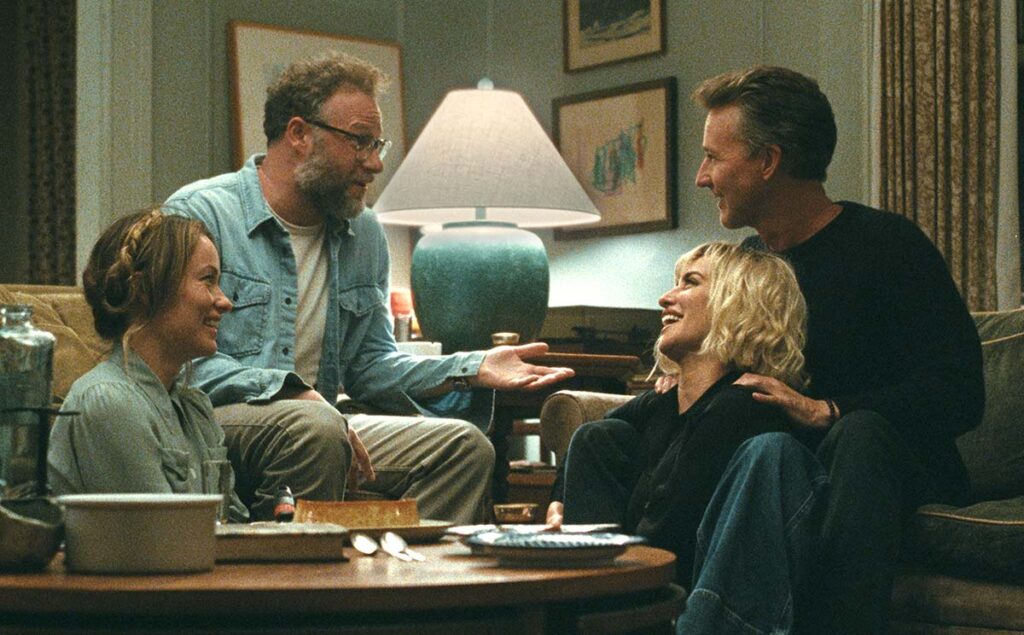
At the start of the film, Joe and Angela are in trouble. They’re lying, they’re yelling, they’re fighting, and they seem to be on the rocks. When Piña and Hawk arrive for dinner, they look much the opposite. They’re speaking to each other in Spanish, complimenting each other constantly, and generally looking like a perfect couple, not all that far from a relationship viewed through Instagram-tinted glasses. It’s here the great Comedy of the film begins. As circumstances split up the couples and leave them alone with each other’s spouses, Joe and Angela begin to fall for the perfect partner their counterparts seem to have. Angela is falling for the charms of Hawk, his firefighter background, his love for interior décor, and his grasp on the emotional impact of the shade of blue paint that covers the bedroom wall. For Joe, it’s feeling understood and chosen by Piña, her appreciation for his music, and her shared affinity for the effects of marijuana. Joe and Angela both feel more appreciated and understood by a stranger than by their spouse. Then, the couples return to the living room, and we learn that Piña and Hawk are swingers, a fact that Joe and Angela are incredibly jealous of. For a moment, I’d begun to think this was an argument for wife-swapping, and I was beginning to regret my choice of movies that evening. Slowly, however, the tides began to turn.
After an attempt, a back injury brings everyone back together suddenly, and with Joe writhing on the floor and Piña playing therapist, we discover what is going wrong in Joe and Angela’s marriage. She feels trapped and undervalued, he feels like a failure and a loser, unable to bring himself to play his once prized piano. Piña and Hawk jump at each other’s throats over him correcting her English, leading to a fight that resembles what we’ve seen out of Joe and Angela for the whole film, completely shattering that “model-couple” image. We see that they are just as flawed as any other couple (something that no amount of free love or sexual exploration can change), but much like in our social media crazed lives, the image they project looks flawless, and they are the idols. They might seem happy and emotionally evolved but, beneath the veneer, they are still just two people who don’t always get along. Joe and Angela are us, they’re the disenchanted, the disengaged, and the idolizers. They see what they have as less valuable, less special, and less important than what they thought they saw in Piña and Hawk. At Piña’s prompting, they tell the story of how they fell in love, and eventually what led them to fall apart. Then, in what I believe is the best quote in the movie, Piña tells them “I think we only get a few chances at meaningful relationships, usually we move to different people, sometimes we can have a new relationship with the same people. But I think this relationship is over.”
That quote is the part that has stuck with me since I left the theater, it is why I am sitting here writing this article. If you feel as though your relationship is over, as though this person you once envisioned your life with is no longer the person you want, I can imagine it speaking to you. Sometimes that relationship is over. But it’s the bit before that sticks out. We only get so many connections, so many sparks. You can bail in the lows to chase the highs, you can search for perfection, or as the film shows, you can build the good. The film began with Angela and Joe playing that piano, stitched with a quote from Oscar Wilde’s A Woman of No Importance: “One should always be in love. That’s the reason one should never marry.” It ends with Joe and Angela, alone in their apartment, not sure what to do. Angela goes to bed, Joe elects to sleep in his office. As she lies in bed, she sees him playing the piano, and we see her join him in that same melody from the beginning. It comes full circle. Their relationship was over, but they weren’t.
As I said earlier, I was not expecting this film to defend marriage, or advocate for yours, but it does both. It shows the beauty in a couple that can bend for each other and their children. It shows the imperfect purity of a lifelong commitment. And it reminds us that sometimes endings are beginnings in a trenchcoat, sometimes forest fires give birth to trees, and perhaps sometimes, the death of a dysfunctional relationship can be the birth of a beautiful one. The Invite says the grass isn’t greener elsewhere, but rather that it grows where you water it. Just ask the swingers upstairs.
